The card is still blank, the class needs a passage, and you already want A Christmas Carol quotes that come from the book, not from a film. A short line from Dickens can sit on a caption, a classroom handout, or the inside of a card.
These A Christmas Carol quotes are taken word for word from the 1843 text in the Project Gutenberg edition, and each one carries a short original note on its context or meaning. You will not find a paraphrase here, and you will not find a line that exists only on screen. The list is grouped by speaker: Scrooge, Marley's Ghost, the three Spirits, Tiny Tim, and then Fred and Fezziwig.
Here are 30 lines from the 1843 book for cards, captions, and classroom work.
Scrooge Quotes from A Christmas Carol
These Scrooge quotes follow Ebenezer from his first refusal of Christmas to the change that comes after the Spirits have done their work. The wording is his, taken from the 1843 book.
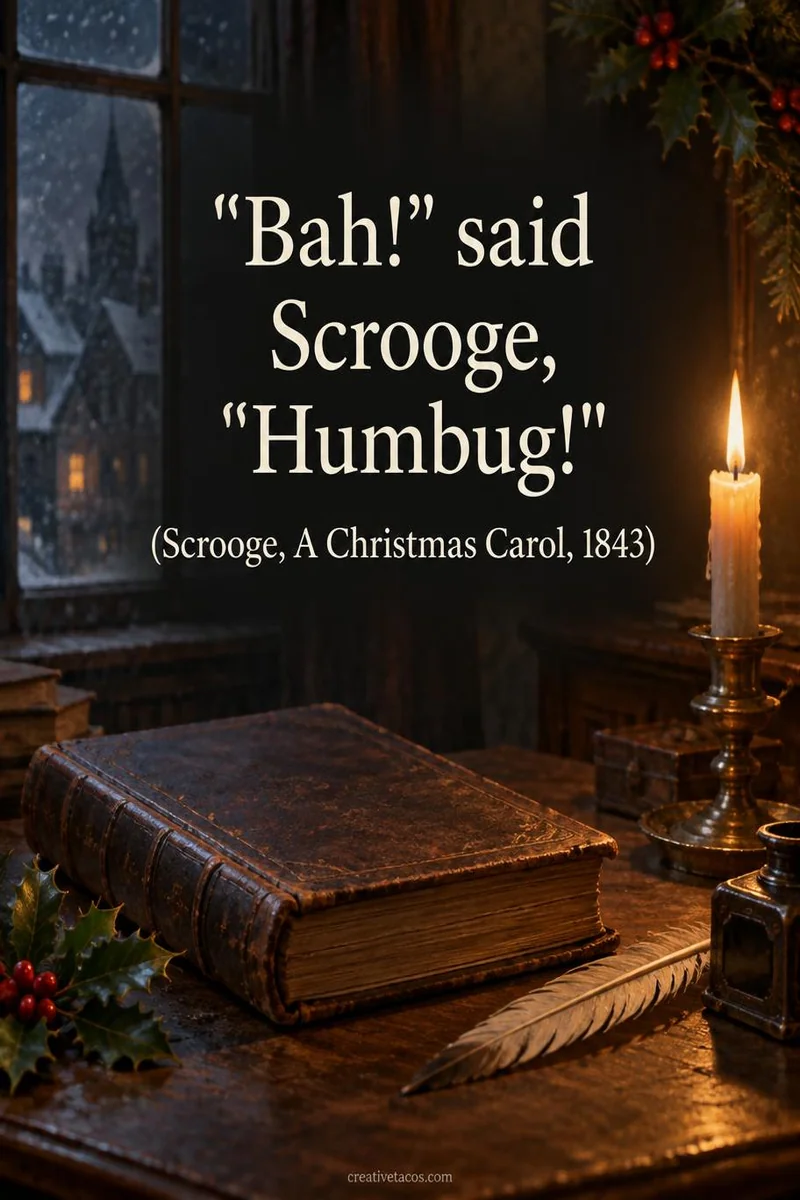
- "Bah!" said Scrooge, "Humbug!" (Scrooge, A Christmas Carol, 1843) This is how Scrooge greets his nephew on Christmas Eve, before any of the ghosts have arrived.
- If I could work my will," said Scrooge indignantly, "every idiot who goes about with 'Merry Christmas' on his lips, should be boiled with his own pudding, and buried with a stake of holly through his heart. He should!" (Scrooge, A Christmas Carol, 1843) The line is comic on the surface, and it also shows how bitterly he wants the season left alone.
- "Are there no prisons?" asked Scrooge. (Scrooge, A Christmas Carol, 1843) He says this to the gentlemen collecting for the poor, as if public institutions were a complete answer to need.
- "If they would rather die," said Scrooge, "they had better do it, and decrease the surplus population. Besides--excuse me--I don't know that." (Scrooge, A Christmas Carol, 1843) The Ghost of Christmas Present will later hand this sentence back to him beside the Cratchit table.
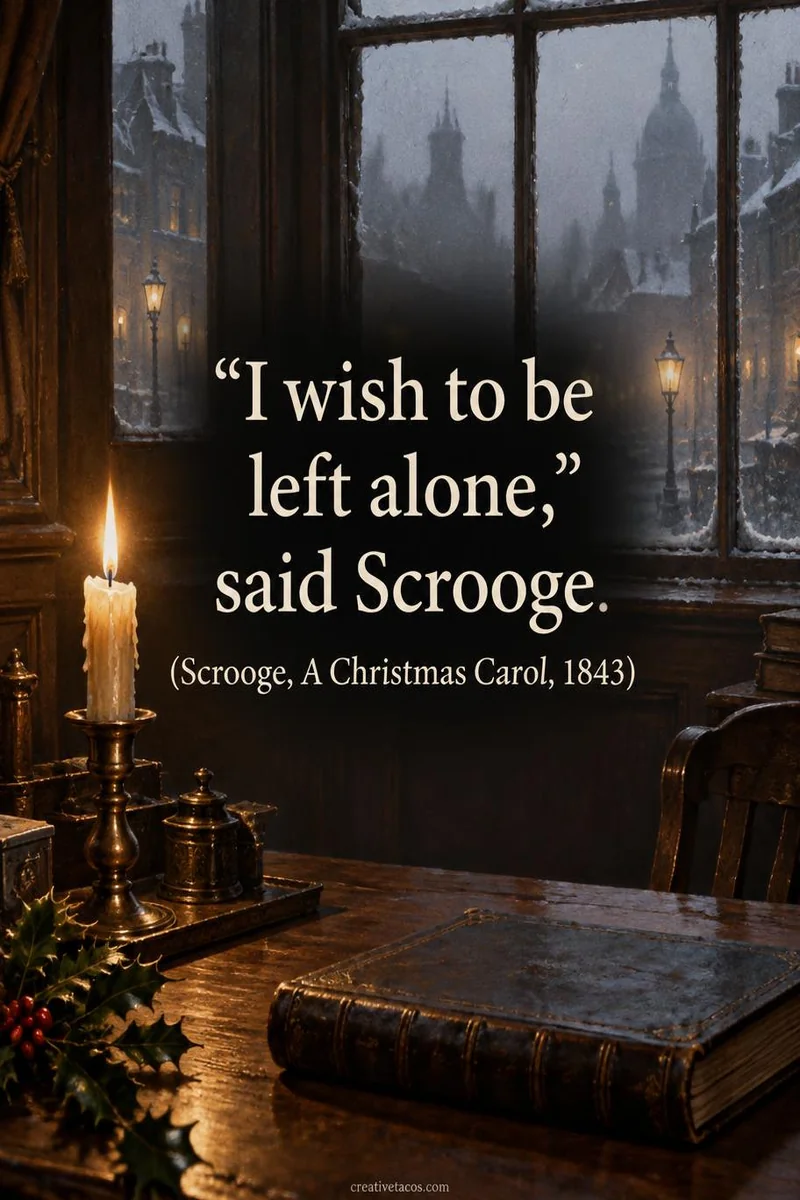
- "I wish to be left alone," said Scrooge. (Scrooge, A Christmas Carol, 1843) He tells the charity collectors that solitude is his preference, and that other people are not his concern.
- "I will honour Christmas in my heart, and try to keep it all the year. I will live in the Past, the Present, and the Future. The Spirits of all Three shall strive within me. I will not shut out the lessons that they teach. Oh, tell me I may sponge away the writing on this stone!" (Scrooge, A Christmas Carol, 1843) Spoken at his own grave, this is the promise that ends the last of the three visits.
Marley Quotes from A Christmas Carol
Marley quotes begin with the book's first fact, then move to the warning Jacob Marley brings in chains. The Ghost speaks as a former partner who learned too late what his business should have been.
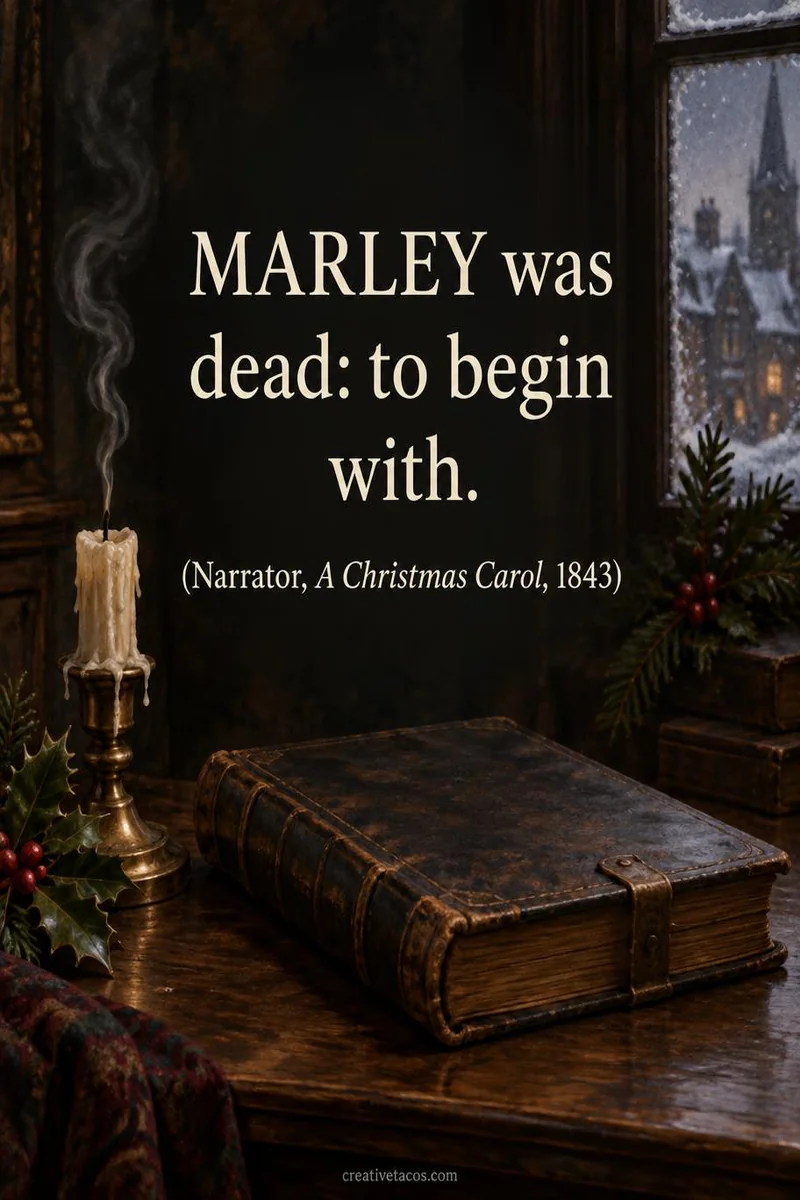
- MARLEY was dead: to begin with. (Narrator, A Christmas Carol, 1843) Dickens opens the book by settling this point first, so the later appearance can feel truly strange.
- Old Marley was as dead as a door-nail. (Narrator, A Christmas Carol, 1843) The narrator pauses on the old saying, then uses it to make the death feel settled and ordinary.
- "I wear the chain I forged in life," replied the Ghost. "I made it link by link, and yard by yard; I girded it on of my own free will, and of my own free will I wore it. Is its pattern strange to you?" (Marley's Ghost, A Christmas Carol, 1843) Marley does not blame chance. He says the chain is work he chose, link by link, while he was still alive.
- "Mankind was my business. The common welfare was my business; charity, mercy, forbearance, and benevolence, were, all, my business. The dealings of my trade were but a drop of water in the comprehensive ocean of my business!" (Marley's Ghost, A Christmas Carol, 1843) He answers Scrooge's talk of business by naming a wider ledger than trade.
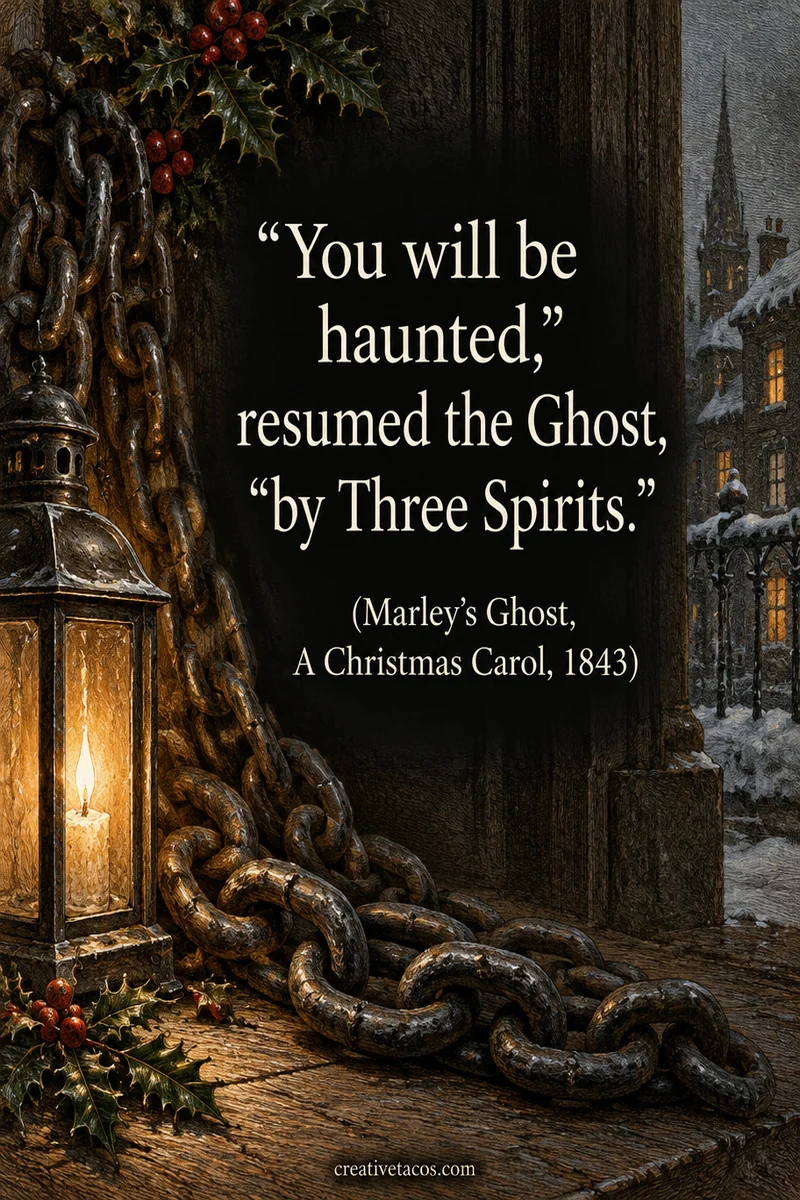
- "You will be haunted," resumed the Ghost, "by Three Spirits." (Marley's Ghost, A Christmas Carol, 1843) This is the warning that sets the rest of the night in motion, after Marley has already shown the cost of his own life.
- "I am here to-night to warn you, that you have yet a chance and hope of escaping my fate. A chance and hope of my procuring, Ebenezer." (Marley's Ghost, A Christmas Carol, 1843) The visit is not only a scolding. Marley says he has procured a chance that he himself did not take.
Quotes from the Three Spirits
Quotes from the three Spirits come from Christmas Past, Christmas Present, and the silent last visitor. Christmas Carol quotes in this section stay with their words, or with the book's own description of the last Spirit.
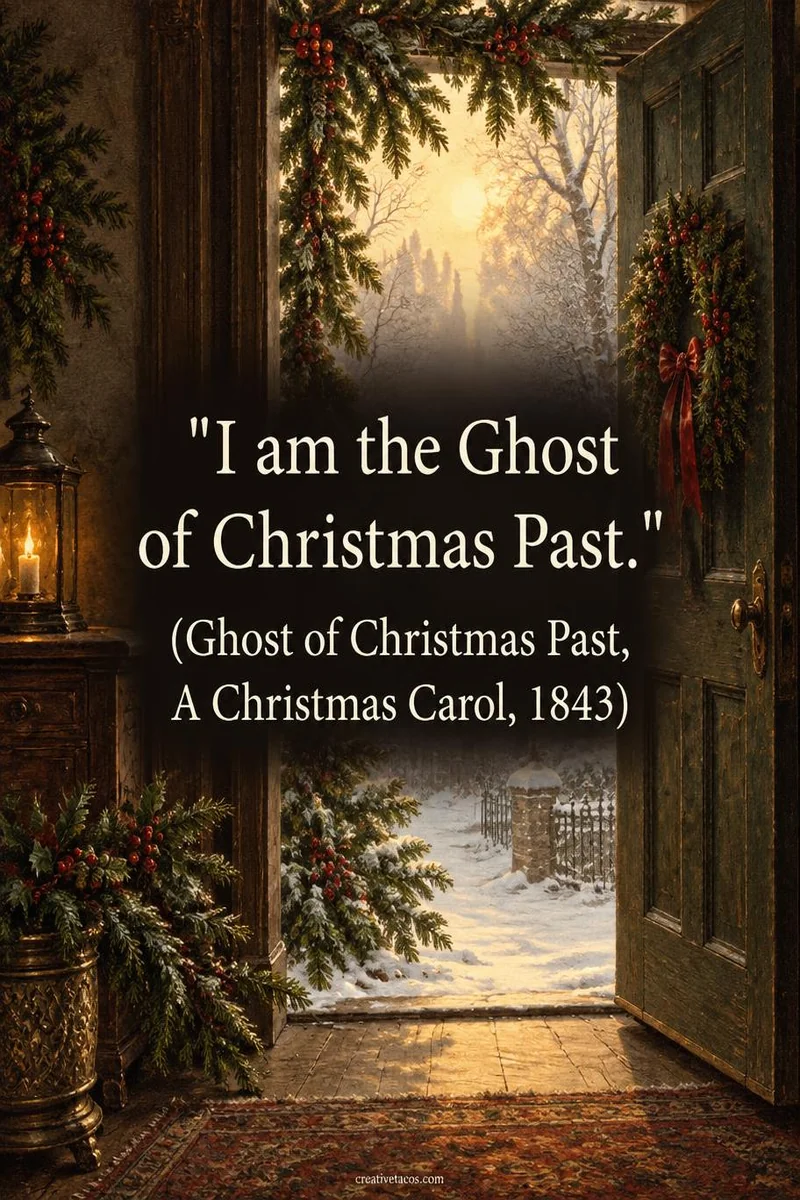
- "I am the Ghost of Christmas Past." (Ghost of Christmas Past, A Christmas Carol, 1843) The first Spirit names itself at once, then leads Scrooge back through rooms he has tried not to visit.
- "These are but shadows of the things that have been," said the Ghost. "They have no consciousness of us." (Ghost of Christmas Past, A Christmas Carol, 1843) The past can be seen, but it cannot be interrupted. Scrooge is there to look, not to rewrite the hour.
- "Come in!" exclaimed the Ghost. "Come in! and know me better, man!" (Ghost of Christmas Present, A Christmas Carol, 1843) The second Spirit meets Scrooge with an open invitation, not a locked door, and asks to be known.
- "I am the Ghost of Christmas Present," said the Spirit. "Look upon me!" (Ghost of Christmas Present, A Christmas Carol, 1843) He asks to be seen in full, in a room overflowing with the plenty of the current Christmas.
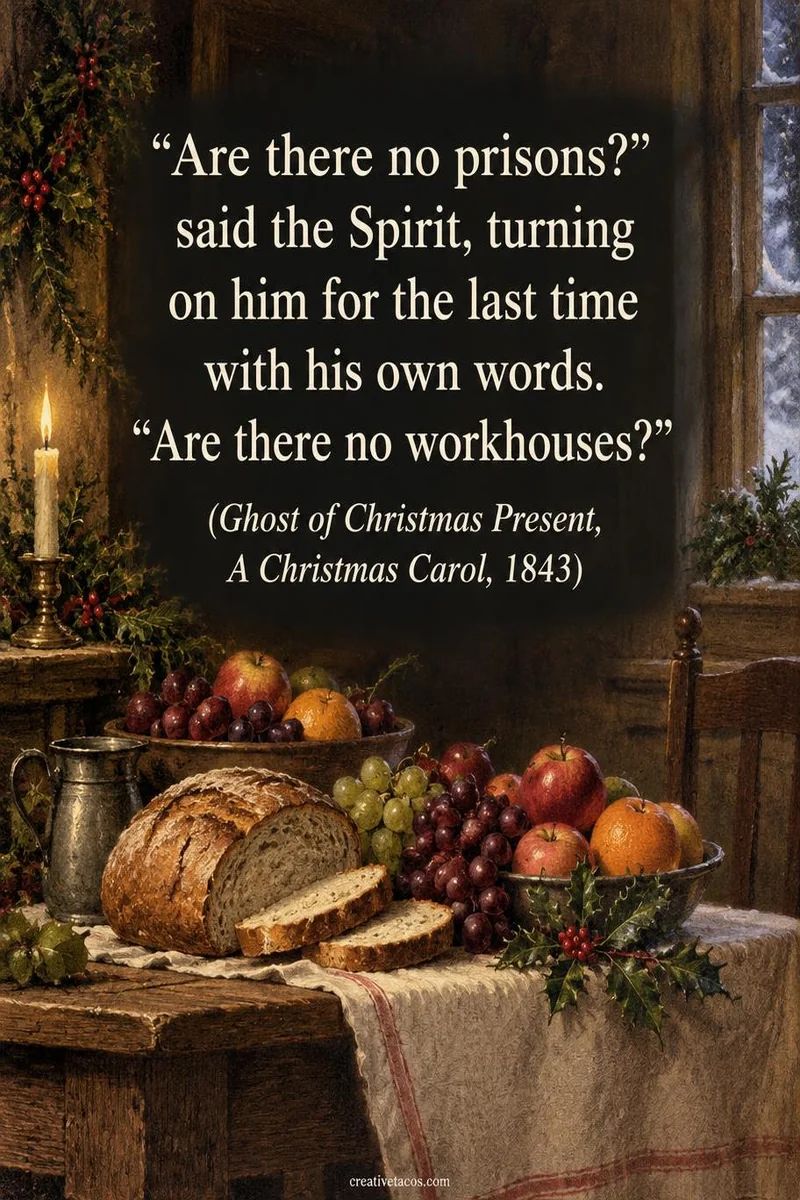
- "Are there no prisons?" said the Spirit, turning on him for the last time with his own words. "Are there no workhouses?" (Ghost of Christmas Present, A Christmas Carol, 1843) The Spirit repeats Scrooge's earlier questions after showing him want that prisons cannot solve.
- It was shrouded in a deep black garment, which concealed its head, its face, its form, and left nothing of it visible save one outstretched hand. (Narrator, A Christmas Carol, 1843) The last of the Spirits does not introduce itself in speech. The book gives us a hidden figure and a pointing hand.
Tiny Tim Quotes from A Christmas Carol
Tiny Tim quotes are few, so this section also keeps the lines around him: Bob Cratchit's report, Scrooge's sudden question, and the book's last blessing. The speakers are labeled so the words stay with the right voice.
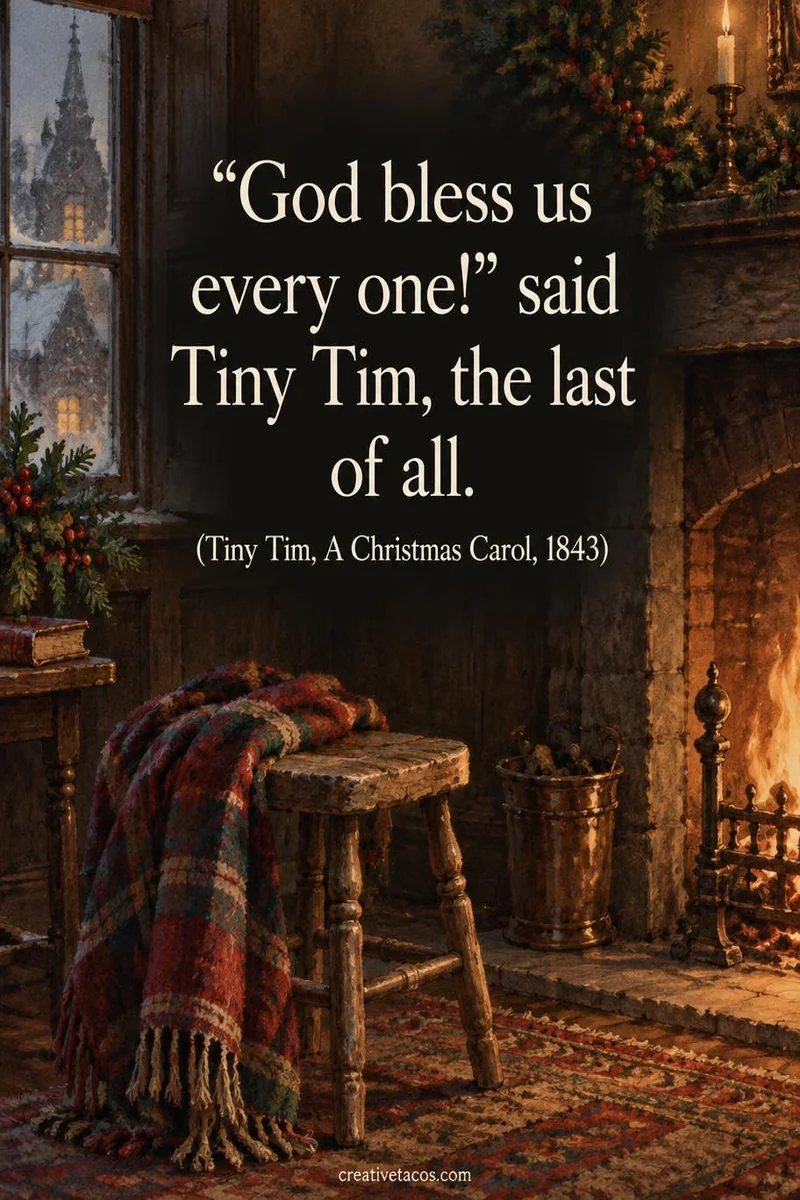
- "God bless us every one!" said Tiny Tim, the last of all. (Tiny Tim, A Christmas Carol, 1843) He speaks last at the Cratchit Christmas dinner, and the book later returns to this blessing as a final line.
- "As good as gold," said Bob, "and better. (Bob Cratchit, A Christmas Carol, 1843) Bob says this of Tiny Tim on Christmas Day, with a father's pride that is also a little afraid.
- He told me, coming home, that he hoped the people saw him in the church, because he was a cripple, and it might be pleasant to them to remember upon Christmas Day, who made lame beggars walk, and blind men see. (Bob Cratchit, reporting Tiny Tim, A Christmas Carol, 1843) These are Tiny Tim's thoughts as Bob recalls them, after the walk home from church.
- "Spirit," said Scrooge, with an interest he had never felt before, "tell me if Tiny Tim will live." (Scrooge, A Christmas Carol, 1843) The question marks the turn in Scrooge. He is no longer watching the family as a stranger.
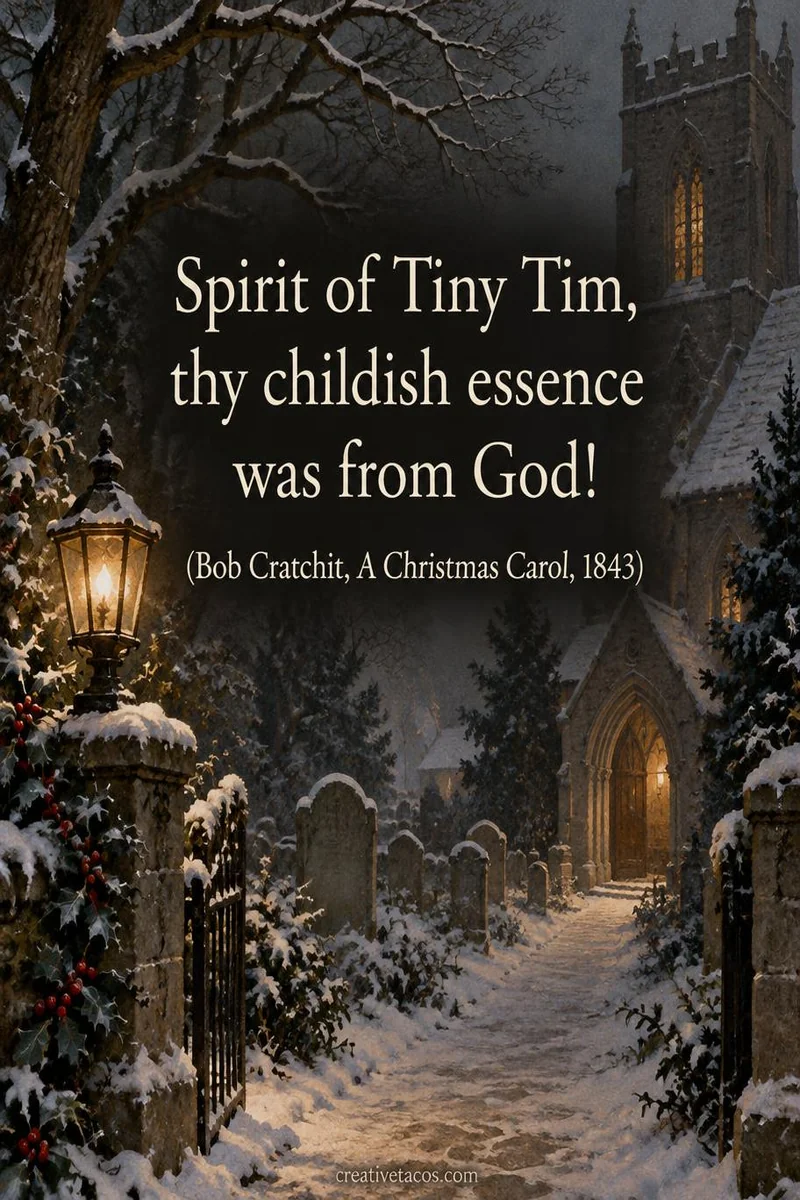
- Spirit of Tiny Tim, thy childish essence was from God! (Bob Cratchit, A Christmas Carol, 1843) In the future vision, Bob speaks this over the child he has lost, before the last Spirit moves Scrooge on.
- And so, as Tiny Tim observed, God bless Us, Every One! (Narrator, after Tiny Tim, A Christmas Carol, 1843) The book ends by bringing Tim's blessing back, now spoken as a wish for the reader as well.
Fred and Fezziwig Quotes from A Christmas Carol
Fred and Fezziwig quotes belong to the two men who keep Christmas without waiting for Scrooge to approve. Fred is the nephew at the office door. Fezziwig is the old master who could close the ledgers and open the room.
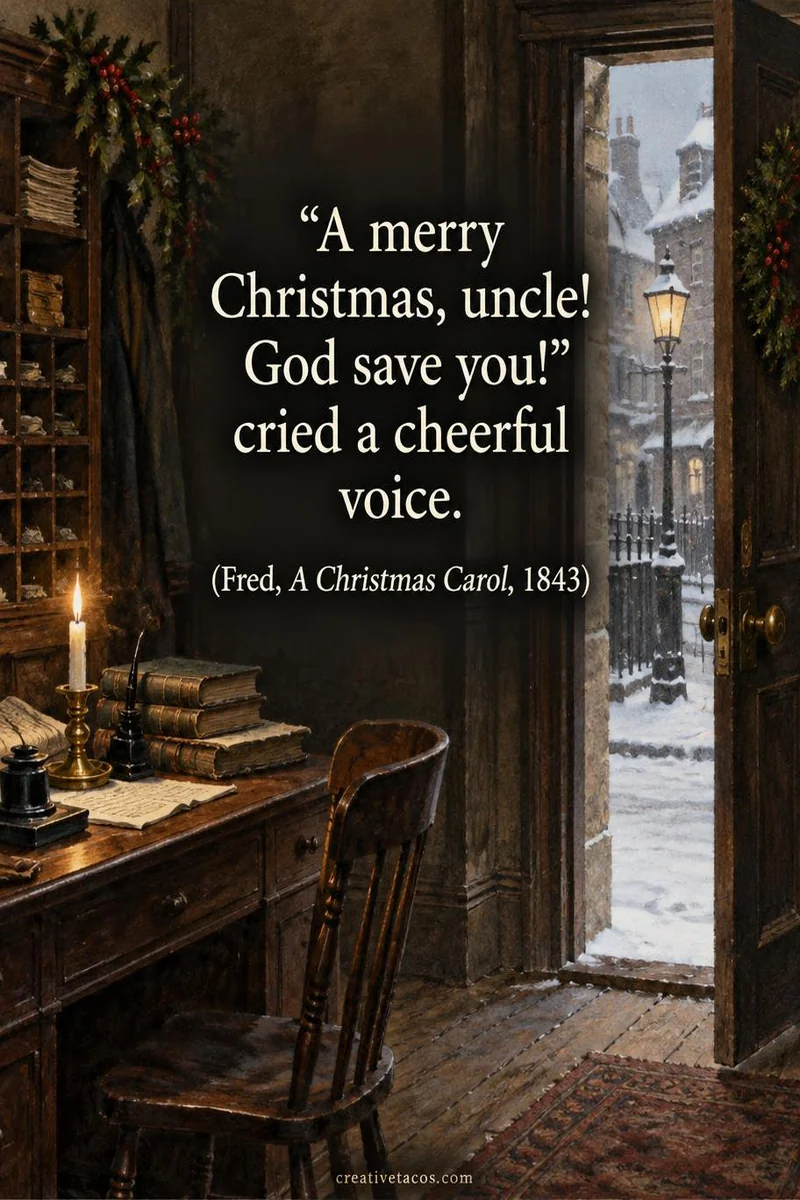
- "A merry Christmas, uncle! God save you!" cried a cheerful voice. (Fred, A Christmas Carol, 1843) Fred arrives in the counting-house with a greeting Scrooge is not ready to return.
- But I am sure I have always thought of Christmas time, when it has come round--apart from the veneration due to its sacred name and origin, if anything belonging to it can be apart from that--as a good time; a kind, forgiving, charitable, pleasant time; (Fred, A Christmas Carol, 1843) This is Fred's case for the season, made in the same visit, after Scrooge has called Christmas a humbug.
- But I have made the trial in homage to Christmas, and I'll keep my Christmas humour to the last. So A Merry Christmas, uncle!" (Fred, A Christmas Carol, 1843) Even after the refusal, Fred keeps the greeting and leaves without an angry word.
- "A Merry Christmas and a Happy New Year to the old man, whatever he is!" said Scrooge's nephew (Fred, A Christmas Carol, 1843) Later, at his own party, Fred still drinks to his uncle, without pretending the old man has been kind.
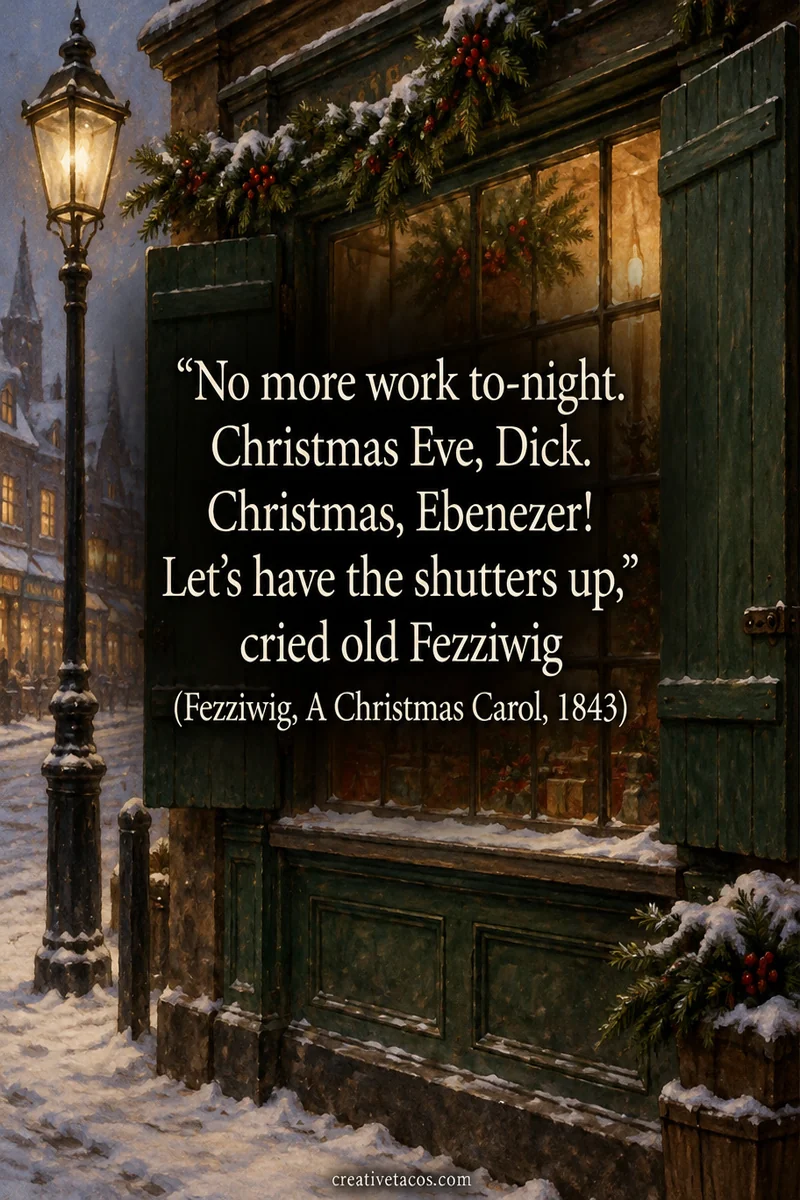
- "No more work to-night. Christmas Eve, Dick. Christmas, Ebenezer! Let's have the shutters up," cried old Fezziwig (Fezziwig, A Christmas Carol, 1843) Fezziwig shuts the office on Christmas Eve and turns the room into a dance, with no delay and no fuss.
- The happiness he gives, is quite as great as if it cost a fortune." (Scrooge, about Fezziwig, A Christmas Carol, 1843) Watching his old master, Scrooge sees that a little power, used kindly, can feel as large as wealth.
How to Use These A Christmas Carol Quotes
Copy a Line Into a Card
A short Scrooge, Fred, or Tiny Tim excerpt can sit inside a holiday card, with the speaker and the 1843 date kept in small type. For more seasonal wording that is not from Dickens, see our Christmas quotes and family Christmas quotes.
Use a Quote as a Caption
A compact line such as Marley's warning, or Scrooge's later promise, can caption a photo of a book, a candle, or a classroom board. If you want night-before lines that are not from this story, browse our Christmas Eve quotes and December quotes.
Bring a Passage Into Classroom Work
These excerpts are taken from a public-domain book, so they can be read aloud, compared by speaker, or set beside a short written response. Keep the wording exact, and keep the speaker label so a discussion stays with the text.
Keep Book Lines Separate From Film Lines
This list stays with the 1843 book. If you want dialogue that lives in a holiday film instead, use our Christmas movie quotes. For original verse rather than Dickens, see our Christmas poems.
FAQ
What are good A Christmas Carol quotes for a card?
Try "Bah!" said Scrooge, "Humbug!" if you want a familiar short line, or Tiny Tim's "God bless us every one!" if you want a blessing. Keep the speaker and the 1843 date so the card stays honest about the source.
Are these Christmas Carol quotes from the book or from a film?
They are from the 1843 book, checked word for word against the Project Gutenberg text. Lines that appear only in a film are not on this list.
What is a good A Christmas Carol quote for a classroom discussion?
Fred's description of Christmas as a kind, forgiving, charitable, pleasant time is a strong start, and so is Marley's "Mankind was my business." Both open a clear question about what the book thinks a person owes other people.
Who says "God bless us every one"?
Tiny Tim says it at the Cratchit dinner: "God bless us every one!" said Tiny Tim, the last of all. The narrator brings a form of the same blessing back in the final sentence of the book.
Can I use these quotes in a caption or a handout?
Yes. A Christmas Carol (1843) is in the public domain, and the excerpts here follow the Project Gutenberg wording. The notes on this page are original and can stay with the lines if they help a reader.
Conclusion
A Christmas Carol still works because the voices stay clear: Scrooge at the door, Marley in the chain, the Spirits at their work, Tiny Tim at the table, and Fred and Fezziwig keeping the feast anyway. Copy a short excerpt for a card or a caption, and keep the speaker in view. Read a longer one with a class and let the note start the discussion, not replace the book. However you use these lines, may the wording stay exact, and may the meaning still have room to move.